

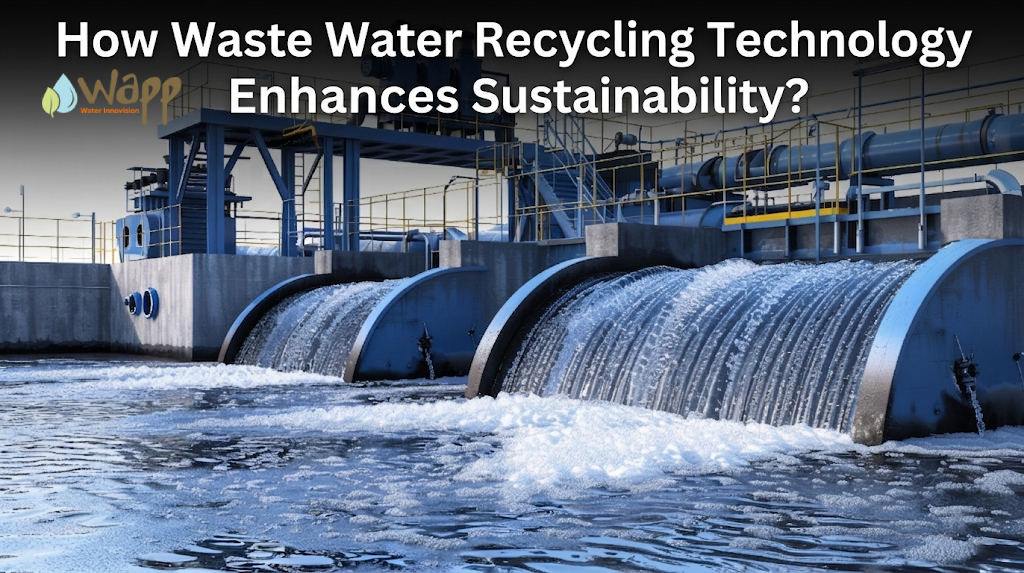
Learn in this blog how waste water recycling technology transforms industrial wastewater into a valuable resource, promoting sustainability and efficiency.
Waste water recycling technology is adopted for channeling wastewater into multiple purposes to replace peak freshwater demand. This limits the environmental footprint to an extensive level. Also, advanced treatment methods improve the quality of water and support legal compliance. Therefore, the adoption of wastewater recycling in modern industries transforms the industrial wastewater into a valuable resource and improves sustainability.
Role of Waste Water Recycling Technology in Improving Sustainability
To improve environmental sustainability in industry, the wastewater recycling technology has been a milestone.
1. Reducing Environmental Pollution
The inclusion of wastewater recycling technology in total water management services has prevented the continuous emission of untreated effluent into rivers, lakes, and other natural water bodies. Moreover, it removes harmful chemicals, solids, and biological toxins before using or discharging the wastewater. Thus, this recycling technology minimizes the total volume of wastewater, limiting potential risks. Alongside this, it also supports modern industries to meet multiple strict environmental laws and sustainability standards.
2. Improving Energy Efficiency
Wastewater recycling technology has improved the sustainability level by transforming high-energy treatment processes into energy-efficient systems. Conventional wastewater treatment processes consume around 60% of a plant’s energy usage. In contrast, advanced recycling technology optimizes energy savings by 20-30% using significant mechanisms. For example, direct energy recovery like biogas production, hydropower, and IoT-enabled process optimization has proven energy efficacy rates.
3. Promoting Resource Conservation
Treated wastewater can be reused for multiple processes, including irrigation, industrial purposes, and groundwater replenishment. Therefore, wastewater recycling technology is crucial for sustainability and improving resource conservation. The increasing dependence on groundwater can be relieved with treated wastewater. So, freshwater needs to be sourced only for drinking purposes rather than for industrial purposes. This further enhances water security and minimizes energy consumption in comparison to desalination, thereby supporting a circular economy and resilience to climate change.
Conclusion
As a whole, the adoption of waste water recycling technology protects ecosystems, improves water quality, and promotes responsible industrial operations. Due to this, industries are able to abide by regulations and also maintain sustainability without any disruption. For recycling your wastewater efficiently and implementing sustainable operations in your organization, contact Enhanced WAPP Systems (I) Pvt Ltd. to get advanced wastewater treatment solutions. Get a quote, +91 97178 40888
FAQs
1. How can wastewater treatment solutions be improved to make them more sustainable and efficient?
Wastewater treatment solutions from providers like Wapp integrate advanced technology, optimally regularize processes, and promote water reuse for enhanced sustainability and efficiency.
2. What are the core benefits of recycling wastewater?
Core benefits of wastewater recycling include wide water resource conservation and extensive pollution reduction.
3. Can recycled wastewater be reused in industrial processes?
Yes, industrial wastewater can be recycled and also repeatedly used in several organizational processes.